
E-commerce has become one of the most competitive and unforgiving categories in mobile app development. A generic consumer app can survive a rough edge or two. An e-commerce app can’t afford a slow product page to lose a browsing customer, a confusing checkout step loses a cart, and a payment failure at the final screen loses a sale that was already won. The margin for error is thin, and most businesses only discover their development partner’s weak points after the app is live and losing money on it.
In 2026, the bar for what an e-commerce app needs to do has moved well past a product catalog and a checkout button. Shoppers expect AI-powered recommendations, one-tap payment options like Apple Pay and Google Pay, real-time order tracking, and increasingly, AR-based product visualization for categories like furniture and apparel. Businesses need the app to connect cleanly to inventory systems, shipping providers, CRM tools, and payment processors, all while staying PCI DSS-compliant and fast under real traffic. Finding a development partner who can deliver all of that reliably is harder than most founders expect going in.
This guide covers the top 10 e-commerce app development companies in the USA for 2026, evaluated on verified commerce delivery experience, platform and integration depth, security compliance, and documented client outcomes. Whether you’re a DTC startup building your first MVP or an established retailer modernizing legacy commerce infrastructure, this list gives you a grounded starting point.
What Is E-commerce App Development?
E-commerce app development is the process of building software mobile, web, or both that lets businesses sell products or services directly to customers through a digital storefront. It spans DTC shopping apps, multi-vendor marketplace platforms, B2B ordering portals, and omnichannel systems that connect online and in-store inventory for larger retailers.
On the technical side, e-commerce development involves choosing a platform layer Shopify Plus, Magento, BigCommerce, or a fully custom-built backend and building an integration layer that connects it to payment gateways, inventory and warehouse systems, shipping carriers, CRM and email tools, and analytics platforms. On the compliance side, it requires PCI DSS-compliant handling of any card payment data, and GDPR-aware data practices for any business serving EU customers. A firm without e-commerce-specific delivery experience tends to underestimate this scope until it becomes an expensive mid-project surprise.
Top 10 E-commerce App Development Companies in USA 2026
| Company | Best For | Key Services | Compliance Credentials | Pricing Range | Delivery Time |
| The Hashtech | E-commerce apps for USA & GCC markets | Custom shopping apps, marketplace platforms, AI-powered recommendations | PCI DSS-aware architecture, secure cloud | Medium | 10–20 weeks |
| Chop Dawg | High-volume conversion-focused apps | Native iOS/Android commerce apps, custom software | PCI DSS-aligned builds | Medium–High | 12–24 weeks |
| Codal | Enterprise Shopify Plus & headless commerce | Shopify Plus development, migrations, headless commerce | Shopify Platinum Partner, PCI DSS | High | 14–28 weeks |
| Simform | Scalable custom commerce platforms | Custom app development, cloud architecture, AI/ML | SOC 2, enterprise cloud security | Medium–High | 14–26 weeks |
| Blue Label Labs | UX-first shopping app experiences | Product strategy, UX research, mobile app development | PCI DSS-aware payment flows | Medium–High | 12–24 weeks |
| Saritasa | Mid-market custom commerce builds | Custom mobile/web apps, cloud engineering, QA | SOC 2-aligned practices | Medium | 10–22 weeks |
| Mercury Development | Enterprise-grade commerce engineering | Custom software development, platform integration | ISO 27001, GDPR-aware | Medium–High | 12–26 weeks |
| Webkul | Open-source & multi-vendor marketplaces | Magento, Shopify, multi-vendor marketplace development | PCI DSS, GDPR compliance | Low–Medium | 8–20 weeks |
| Apptunix | Omnichannel B2B/B2C/D2C commerce apps | Custom commerce apps, AI recommendations, inventory management | PCI DSS-aware architecture | Medium | 10–22 weeks |
| Zazz | Startup-friendly rapid commerce MVPs | MVP development, AI/AR features, mobile commerce | PCI DSS-aware builds | Low–Medium | 8–18 weeks |
1. The Hashtech
Price per service: $8,000 – $65,000
Money-back guarantee: Yes
Delivery time: 10–20 weeks
Overview
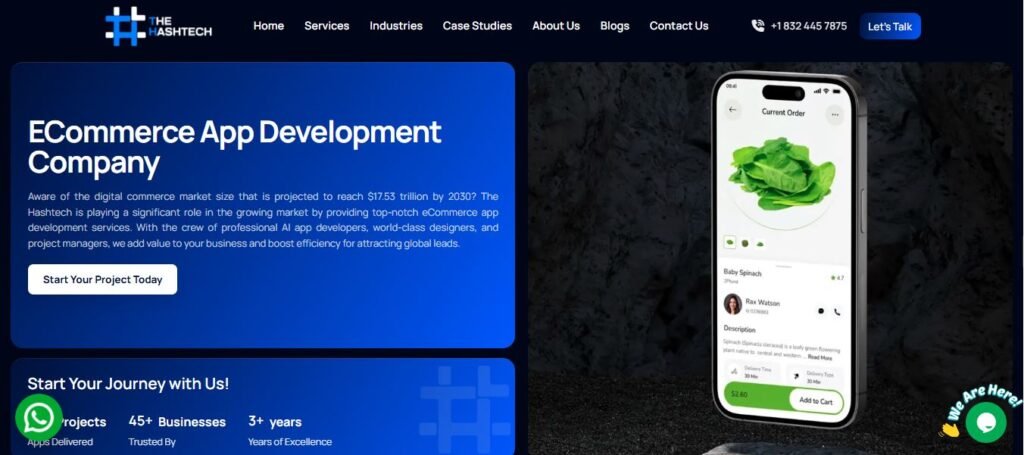
The Hashtech is a full-service mobile app development company serving e-commerce clients across the United States and the GCC region, including Saudi Arabia and the UAE. Their e-commerce practice covers custom shopping apps, multi-vendor marketplace platforms, and AI-powered product recommendation engines, built primarily with React Native and Flutter for cross-platform delivery.
Every project starts with a payment and inventory architecture review before design work begins, mapping how the app will connect to payment gateways, warehouse or dropship inventory systems, and shipping providers, so integration issues surface during planning rather than after launch. Their cloud infrastructure work runs on AWS and Azure, with checkout flows built around PCI DSS-aware handling of card data from the start.
Their dual-market experience across the US and GCC is a genuine differentiator in this category. Saudi Arabia and the UAE have among the fastest-growing e-commerce markets globally, driven by high smartphone penetration and rapid digital payment adoption, and few US-serving development firms have real delivery history spanning both regions.
Why Choose The Hashtech
The Hashtech fits DTC brands, retailers, and marketplace startups that want a responsive, hands-on development partner without enterprise-consultancy pricing or overhead. Their architecture-first process- reviewing payment, inventory, and shipping integration needs before development starts helps clients avoid the scope creep that derails a lot of e-commerce builds once real transaction volume hits.
For businesses selling into both US and GCC markets, their cross-regional delivery experience removes the need to manage separate development relationships for each geography a real advantage for anyone expanding into the Middle East commerce market.
Our Experience
Hashtech’s discovery phase for our multi-vendor marketplace identified a payment settlement timing issue between our US and GCC payment processors that would have caused vendor payout delays post-launch. That was resolved before development began. The delivered app handled our launch-day traffic without checkout failures, and the recommendation engine started improving conversion within the first month live.
Pros & Cons
| Pros | Cons |
| Strong USA & GCC dual-market commerce expertise | Less brand recognition than large enterprise firms |
| Payment-and-inventory-architecture-first approach | High demand can affect onboarding timelines |
| Transparent milestone-based delivery |
2. Chop Dawg
Price per service: $20,000 – $200,000+
Money-back guarantee: Varies by engagement
Delivery time: 12–24 weeks
Overview
Chop Dawg is a Philadelphia-based app development company operating since 2009, with 500+ product launches across iOS, Android, and web. Their e-commerce work centers on native mobile shopping apps built for fast product browsing, streamlined checkout, and personalization designed to lift transaction value rather than just look polished. Their track record includes 300+ five-star reviews across Clutch, GoodFirms, G2, and other review directories, with client work spanning DTC retail, marketplace platforms, and subscription commerce.
Why Choose Chop Dawg
Chop Dawg suits established retailers and DTC brands that need a native mobile app built specifically to improve conversion metrics, backed by a firm with a long, well-documented delivery history across the review directories that matter most in vendor evaluation.
Our Experience
Chop Dawg rebuilt our checkout flow around a shorter, conversion-optimized sequence and integrated Apple Pay and Google Pay support. Post-launch, our mobile checkout completion rate improved noticeably, and the team stayed responsive through several rounds of post-launch refinement.
Pros & Cons
| Pros | Cons |
| 500+ apps launched since 2009 | Premium pricing for smaller projects |
| Extensive verified review history across multiple platforms | Native-first approach may not suit web-first commerce needs |
| Conversion-focused development philosophy |
3. Codal

Price per service: $30,000 – $400,000+
Money-back guarantee: Yes
Delivery time: 14–28 weeks
Overview
Codal is a Los Angeles-based digital agency founded in 2009, recognized as one of a small number of Shopify Platinum Partners in the US. They specialize in enterprise Shopify Plus development, platform migrations, and headless commerce architecture, with a 270+ person global team. Their client work includes building a custom logistics management app for Flexport that integrates ocean freight shipping and rate comparison directly into merchants’ Shopify dashboards, and enterprise brand engagements spanning consumer goods and DTC manufacturing. As a two-time BigCommerce Agency of the Year and AWS Advanced Tier partner, their platform-partner credentials run deep across the major enterprise commerce ecosystems.
Why Choose Codal
Codal is the strongest choice for enterprise and mid-market brands running on Shopify Plus or BigCommerce that need complex platform migrations, custom app development within the platform ecosystem, or a move to headless commerce architecture for maximum frontend flexibility.
Our Experience
Codal migrated our legacy platform to Shopify Plus and rebuilt our product customization feature during the process. The migration preserved all historical order data, and the new customization flow performed well with customers from launch no rollback or major post-launch fixes needed.
Pros & Cons
| Pros | Cons |
| Shopify Platinum Partner, one of a handful in the US | Premium pricing tier best suited to established brands |
| Proven enterprise migration and headless commerce delivery | Longer timelines for complex enterprise migrations |
| Strong multi-platform credentials (Shopify, BigCommerce, AWS) |
4. Simform
Price per service: $25,000 – $300,000+
Money-back guarantee: Yes
Delivery time: 14–26 weeks
Overview
Simform is a custom software development firm with deep expertise in cloud architecture, AI/ML integration, and scalable platform engineering for high-growth e-commerce brands. Their e-commerce practice focuses on custom-built platforms designed to handle rapid growth without the performance degradation that off-the-shelf platforms can hit at scale. Their engineering approach leans on cloud-native architecture and DevOps practices, making them a fit for brands that expect traffic and catalog size to grow substantially post-launch.
Why Choose Simform
Simform fits high-growth e-commerce brands and marketplace startups that anticipate rapid scaling and need custom-built, cloud-native architecture rather than an off-the-shelf platform that may hit performance ceilings as transaction volume grows.
Our Experience
Simform built a custom commerce backend for our subscription-based product line, engineered to handle seasonal traffic spikes without manual scaling. Our peak-season traffic tripled year over year, and the platform held up without downtime or checkout slowdowns.
Pros & Cons
| Pros | Cons |
| Strong cloud-native and scalable architecture expertise | Custom-build approach carries higher upfront cost |
| AI/ML integration capability for personalization at scale | Better suited to growth-stage than early MVP validation |
| DevOps-first engineering culture |
5. Blue Label Labs
Price per service: $30,000 – $250,000+
Money-back guarantee: Yes
Delivery time: 12–24 weeks
Overview
Blue Label Labs is a New York-based product strategy and app development agency known for user-centered design across consumer-facing apps, including e-commerce. Their process leans heavily on discovery workshops and UX research before development starts, mapping how shoppers actually move through product discovery, comparison, and checkout. In a category where a confusing checkout step directly costs a sale, this research-led approach to reducing friction is their clearest differentiator from firms that start with engineering rather than user behavior.
Why Choose Blue Label Labs
Blue Label Labs is the right choice when checkout UX and shopper experience quality are the primary competitive differentiator for a brand, and the team wants a partner who validates flow assumptions with real user research before writing code.
Our Experience
Blue Label Labs ran user testing sessions on our original checkout design and found a step that was causing unexpected drop-off among first-time buyers. The redesigned flow they delivered tested meaningfully better, and the build stayed on schedule through launch.
Pros & Cons
| Pros | Cons |
| Strong UX research and discovery-led process | UX-first approach may extend discovery timelines |
| Deep experience with consumer-facing product design | Less focused on heavy backend/inventory engineering |
| Proven track record with early and growth-stage brands |
6. Saritasa
Price per service: $15,000 – $150,000+
Money-back guarantee: Yes
Delivery time: 10–22 weeks
Overview
Saritasa is a US-based custom software development firm serving mid-market e-commerce and retail clients with custom mobile and web applications. Their commerce work spans custom shopping apps, inventory management integrations, and cloud infrastructure for retailers who need functionality beyond what standard platform templates offer. Their QA-focused development process is built around catching payment and checkout edge cases before launch rather than after, which matters directly for conversion and PCI compliance.
Why Choose Saritasa
Saritasa fits mid-market retailers and DTC brands that need custom functionality beyond template-based platforms, at a price point below the largest enterprise agencies on this list.
Our Experience
Saritasa built a custom inventory sync between our online store and physical retail locations. Their QA process caught a stock-count edge case during testing that would have caused overselling during a sale event a detail our previous vendor had missed entirely.
Pros & Cons
| Pros | Cons |
| Strong QA-focused development process | Smaller team scale than the largest firms on this list |
| Solid mid-market pricing relative to enterprise competitors | Less brand recognition in the enterprise segment |
| US-based team for closer collaboration |
7. Mercury Development

Price per service: $30,000 – $300,000+
Money-back guarantee: Yes
Delivery time: 12–26 weeks
Overview
Mercury Development is a custom software engineering firm with ISO 27001 certification and GDPR-aware development practices, serving enterprise e-commerce clients that need deep platform integration work. Their commerce practice focuses on integration-heavy projects connecting e-commerce platforms to ERP systems, complex inventory management, and multi-currency, multi-region payment processing. Their ISO 27001 certification signals a formalized approach to information security that matters for enterprise clients handling large volumes of customer payment and personal data.
Why Choose Mercury Development
Mercury Development suits enterprise retailers with complex backend requirements, ERP integration, multi-region operations, or heavy compliance obligations where formalized security certification and integration depth matter more than fast MVP delivery.
Our Experience
Mercury Development connected our commerce platform to our existing ERP system, syncing inventory and order data in real time across three regional warehouses. The integration held up correctly through our first full quarter without data mismatches between systems.
Pros & Cons
| Pros | Cons |
| ISO 27001 certified with formalized security processes | Enterprise engagement model means longer onboarding |
| Strong ERP and complex integration experience | Less suited to fast, lean MVP builds |
| GDPR-aware development for multi-region brands |
8. Webkul
Price per service: $5,000 – $80,000
Money-back guarantee: Yes
Delivery time: 8–20 weeks
Overview
Webkul is a self-bootstrapped e-commerce development company known for extensive open-source contributions to the Magento and multi-vendor marketplace ecosystem. They specialize in B2B/B2C e-commerce, marketplace platforms, and headless storefronts across Magento, Shopify, and CS-Cart, with a strong focus on multi-vendor marketplace functionality. Their open-source contributions to the Magento community give them unusually deep platform-level knowledge for troubleshooting complex extension conflicts and custom marketplace logic.
Why Choose Webkul
Webkul is the strongest fit for businesses building a multi-vendor marketplace specifically, or brands needing deep Magento expertise at a price point well below the enterprise agencies on this list.
Our Experience
Webkul built our multi-vendor marketplace on Magento, including custom vendor payout logic and a seller dashboard. Their Magento-specific expertise resolved an extension conflict within a day that a previous freelancer had left unresolved for weeks.
Pros & Cons
| Pros | Cons |
| Deep multi-vendor marketplace specialization | Less design-forward than UX-focused agencies |
| Extensive open-source Magento ecosystem contributions | Better suited to marketplace/Magento than broad enterprise builds |
| Most affordable pricing tier on this list |
9. Apptunix

Price per service: $15,000 – $180,000+
Money-back guarantee: Yes
Delivery time: 10–22 weeks
Overview
Apptunix is a full-service e-commerce app development company building feature-rich commerce applications for startups, SMBs, and enterprise clients across B2B, B2C, and D2C business models. Their commerce practice covers omnichannel capabilities that let a brand run consistent inventory and customer data across mobile app, web storefront, and, in some cases, in-store point-of-sale. Their feature set spans AI-powered recommendations, secure payment integration, and inventory management, tailored per client to whichever business model fits.
Why Choose Apptunix
Apptunix fits businesses that need flexibility across business models B2B, B2C, D2C, or marketplace or that want omnichannel functionality connecting mobile, web, and physical retail inventory in one system.
Our Experience
Apptunix built an omnichannel commerce app connecting our online store with our retail point-of-sale system, so inventory stayed accurate whether an item sold online or in-store. The sync has run reliably since launch, with no reported cases of overselling across channels.
Pros & Cons
| Pros | Cons |
| Strong omnichannel and multi-business-model flexibility | Broad service scope means less deep specialization |
| Broad experience across B2B, B2C, and D2C commerce | Project quality can vary by team assignment |
| Competitive mid-market pricing |
10. Zazz
Price per service: $8,000 – $80,000
Money-back guarantee: Yes
Delivery time: 8–18 weeks
Overview
Zazz is a mobile and web app development company known for fast-turnaround MVP builds, including AI- and AR-powered e-commerce features like virtual try-on and product visualization. Their commerce work leans toward startups and early-stage brands that need to validate a commerce concept quickly before committing to a larger engineering investment. Their AI/AR feature work gives early-stage brands access to differentiating features normally associated with much larger agency budgets.
Why Choose Zazz
Zazz is the right fit for early-stage e-commerce founders who need a fast, lean MVP to validate demand before scaling up development investment, with the option to add AI/AR features without a full enterprise budget.
Our Experience
Zazz delivered our MVP with an AR-based try-on feature for our apparel line in under three months. The fast timeline let us test the concept with real customers well ahead of our original launch target, and the AR feature became a strong differentiator in early user feedback.
Pros & Cons
| Pros | Cons |
| Fast MVP delivery timelines, among the shortest on this list | Less suited to complex enterprise integration needs |
| Accessible AI/AR feature development for early-stage budgets | Rapid delivery model trades some discovery depth |
| Lower entry price point |
Final Thoughts
E-commerce app development in 2026 rewards partners who understand that the app is only as good as the checkout experience and the integrations behind it. The gap between a firm that can build a mobile app and a firm that can build a commerce app one that handles payments securely, syncs inventory correctly, and actually converts browsers into buyers is significant.
The Hashtech stands out for founders and retailers who need a responsive partner for both US and GCC market e-commerce apps, combining integration discipline with genuine cross-regional delivery experience. Codal is the specialist’s choice for enterprise Shopify Plus and headless commerce work. Simform and Mercury Development bring the architecture depth needed for rapid scaling or complex ERP integration. Webkul stands out when a multi-vendor marketplace is the core requirement, and Zazz is the fastest path to a validated MVP. Whatever your project scope, the non-negotiables stay the same: verified PCI DSS-aware payment handling, a real integration track record, and a portfolio of commerce apps that are actually driving sales.
FAQs
1. How much does e-commerce app development cost in the USA in 2026?
E-commerce app development costs typically range from $8,000 to $30,000 for a basic MVP with product catalog, cart, and standard checkout, $30,000 to $100,000 for a mid-complexity app with custom features, inventory integration, and personalization, and $100,000 to $400,000 or more for enterprise platforms with headless commerce architecture, ERP integration, and multi-region support. Platform choice affects cost significantly; building on Shopify Plus or BigCommerce is generally faster and cheaper than a fully custom-built backend, since much of the core commerce logic is already handled by the platform.
2. What is the difference between a native e-commerce app and a platform-based one like Shopify?
A native e-commerce app is custom-built from the ground up for iOS and Android, giving full control over design, performance, and feature logic, but requiring more development time and cost. A platform-based app, built on Shopify, BigCommerce, or Magento, uses the platform’s existing commerce engine; payment processing, inventory management, and catalog logic are handled by the platform, and the development work focuses on customization, integrations, and the storefront experience. Platform-based builds are typically faster and less expensive, while native custom builds offer more flexibility for brands with unusual business logic or very large-scale performance requirements.
3. Why does PCI DSS compliance matter for e-commerce app development?
PCI DSS (Payment Card Industry Data Security Standard) compliance matters because any app that processes, stores, or transmits credit card data is required to meet these security standards, and non-compliance can result in fines, increased transaction fees, or the loss of the ability to accept card payments entirely. A development partner that builds PCI DSS-aware payment handling into the app’s architecture from the start rather than retrofitting it after launch avoids costly rework and reduces the business’s liability exposure if a security incident occurs.
4. What features should an e-commerce app include in 2026?
Table-stakes features for a 2026 e-commerce app include fast product search and filtering, a streamlined one-page or few-step checkout, multiple payment options (card, digital wallets like Apple Pay and Google Pay, and increasingly buy-now-pay-later options), and real-time order tracking. More advanced platforms add AI-powered product recommendations based on browsing history, AR-based product visualization for categories like furniture or apparel, and omnichannel inventory sync between the app, website, and physical retail locations. Which features matter most depends on the product category; AR try-on matters far more for apparel and furniture brands than for, say, grocery delivery apps.
5. How long does it take to build an e-commerce app?
A basic MVP with catalog browsing, cart, and standard checkout can launch in 8 to 12 weeks. A mid-complexity app with custom features, third-party integrations (CRM, inventory, shipping), and personalization typically takes 14 to 22 weeks. Enterprise platforms with headless commerce architecture, ERP integration, and multi-region or multi-currency support generally run 24 to 40 weeks. The clearest predictor of timeline is how well-defined the third-party integration requirements are at project start. Payment gateway and inventory system integrations are the most common source of schedule slippage in e-commerce builds.
