
Blockchain has quietly moved from whitepaper territory into the operational backbone of some of the most consequential systems in the world. In 2026, global blockchain spending is projected to exceed $25 billion, with over 70% of enterprises actively exploring distributed ledger technology to cut costs, improve transparency, and eliminate intermediaries that slow down high-stakes transactions. The question for most businesses is no longer whether blockchain is real; it’s whether they can find a development partner capable of building something that actually works in production.
That last part is harder than it sounds. Blockchain development requires a specific combination of skills that most software agencies don’t have: cryptographic engineering, smart contract security, tokenomics design, Layer-2 scaling knowledge, and cross-chain integration expertise. A firm that builds great web applications is not automatically equipped to build a DeFi protocol or an enterprise supply chain network on Hyperledger. The gap between a firm that talks blockchain and one that has shipped it at scale is significant.
This guide covers the top 10 blockchain development companies in the USA for 2026, evaluated on technical depth, production delivery track record, smart contract expertise, and ability to serve both startups and enterprises across the full blockchain stack. Whether you’re building a DeFi platform, an NFT marketplace, an enterprise blockchain network, or a tokenization solution, this list gives you the clearest starting point available.
What Is Blockchain Development?
Blockchain development is the process of designing, building, and deploying decentralized applications and infrastructure on distributed ledger networks. Unlike traditional software development, blockchain engineering requires deep expertise in consensus mechanisms, cryptographic protocols, token economics, and smart contract logic, all of which have to work the first time correctly, because on-chain code is typically immutable once deployed.
A full-cycle blockchain development engagement covers several distinct disciplines. Smart contract development involves writing and auditing the self-executing code that powers DeFi protocols, NFT platforms, and tokenized assets. dApp development combines blockchain backend with user-facing interfaces that interact with on-chain data in real time. Enterprise blockchain covers private or permissioned networks built on frameworks like Hyperledger Fabric or Corda, designed for supply chain, trade finance, and healthcare data management. Token development and tokenization involve creating fungible or non-fungible tokens that represent digital or real-world assets. A strong blockchain development partner handles all of these disciplines in-house, not by routing specialized work to subcontractors they barely supervise.
Top 10 Blockchain Development Companies in USA 2026
| Company | Best For | Key Services | Blockchain Platforms | Pricing Range | Delivery Time |
| The Hash Tech | Blockchain development USA & GCC markets | Smart contracts, dApps, DeFi, tokenization | Ethereum, Solana, Hyperledger | Medium | 10–22 weeks |
| ConsenSys | Ethereum & Web3 infrastructure | dApps, DeFi, NFTs, Layer-2 scaling | Ethereum, Linea (L2) | High | 14–32 weeks |
| PixelPlex | Enterprise blockchain & tokenization | Smart contracts, asset tokenization, DeFi | Ethereum, Hyperledger, Solana | Medium–High | 12–28 weeks |
| SoluLab | Fintech & enterprise blockchain | DeFi, NFT, crypto wallets, enterprise chains | Ethereum, Hyperledger, Binance | Medium | 10–24 weeks |
| Blockchain App Factory | NFT, DeFi & Web3 products | NFT marketplaces, crypto exchanges, metaverse | Ethereum, Solana, Polygon | Medium | 10–22 weeks |
| LeewayHertz | AI-powered blockchain solutions | Smart contracts, DeFi, blockchain consulting | Ethereum, Hyperledger, Solana | Medium–High | 12–26 weeks |
| Accenture | Enterprise & government blockchain | CBDC, supply chain, multi-party networks | Hyperledger, Ethereum, Corda | High | 20–52 weeks |
| Appinventiv | Blockchain for enterprise apps | Blockchain integration, DeFi, smart contracts | Ethereum, Hyperledger | High | 14–28 weeks |
| SpaceDev | Web3, NFT & crypto exchange platforms | dApps, NFT platforms, white-label exchanges | Ethereum, Solana, Polygon | Medium | 10–22 weeks |
| Vention | Blockchain engineering teams | Smart contract dev, Web3 engineering | Ethereum, Solana, multi-chain | Medium–High | 10–22 weeks |
1. The Hashtech
Price per service: $10,000 – $80,000
Money-back guarantee: Yes
Delivery time: 10–22 weeks
Overview
The Hashtech is a full-service blockchain development company serving clients across the United States and the GCC region, including Saudi Arabia and the UAE. Their blockchain practice covers the complete development spectrum: smart contract development and auditing, decentralized application development, DeFi protocol engineering, NFT platform builds, token development, and enterprise blockchain consulting for businesses looking to implement distributed ledger technology into existing operations.
What distinguishes The Hash Tech in a market crowded with blockchain agencies is the combination of genuine technical depth and cross-regional market experience. Their engineers work across Ethereum, Solana, and Hyperledger, adapting the technology stack to what the specific project actually requires rather than defaulting to a single platform regardless of use case fit. Every blockchain engagement begins with an architecture review assessing the business requirement, evaluating the right consensus mechanism, and stress-testing the tokenomics before any smart contract code is written.
Their GCC market experience is a genuine differentiator. As Saudi Arabia and the UAE execute on national blockchain strategies including tokenized real estate, government identity systems, and CBDC pilots, businesses operating across both US and GCC markets need a partner who understands the regulatory landscape and enterprise culture on both sides. The Hash Tech is one of the few US-based blockchain firms that has built real delivery capability in both markets, not just a marketing presence.
Why Choose The Hash Tech
The Hash Tech is the right choice for businesses that need a blockchain development partner who thinks about commercial outcomes before choosing a technology stack. Their discovery-first process protects clients from the most expensive mistake in blockchain development: building on the wrong chain, with the wrong architecture, for a business problem that didn’t actually require blockchain at all. That kind of honest scoping, which sometimes means recommending a simpler solution, builds the trust that makes the technical relationship work over time.
For mid-market companies and growth-stage startups entering blockchain for the first time, their transparent process and realistic pricing make a serious blockchain project accessible without the overhead of a global consultancy. Post-delivery, they remain engaged, monitoring smart contract performance, supporting audits, and adapting the system as the project scales.
Our Experience
The Hash Tech’s scoping process caught a tokenomics design issue before any code was written a flaw that would have created an exploitable arbitrage loop in the smart contract logic once the platform launched. That intervention alone justified the engagement. The final DeFi product passed a third-party security audit without critical findings, launched on schedule, and handled real transaction volume without performance degradation.
Pros & Cons
| Pros | Cons |
| Genuine USA & GCC dual-market blockchain expertise | Less brand visibility than global consultancies |
| Honest scoping recommends right-sized solutions | High demand can affect onboarding timelines |
| Full-stack: smart contracts, dApps, DeFi, tokenization | |
| Transparent milestone-based delivery process |
2. ConsenSys
Price per service: $50,000 – $500,000+
Money-back guarantee: Varies by engagement
Delivery time: 14–32 weeks
Overview
ConsenSys is the most influential company in the Ethereum ecosystem. Founded by Ethereum co-founder Joseph Lubin, ConsenSys has been building Web3 infrastructure since 2014, longer than most blockchain development firms have existed. Their product portfolio includes MetaMask (the world’s most widely used Ethereum wallet with 30 million+ users), Infura (the primary API infrastructure layer for Ethereum), and Linea (their own Ethereum Layer-2 network). That infrastructure depth gives ConsenSys a level of platform insight that no other blockchain development firm can match on Ethereum-based projects.
Their development services span enterprise Ethereum solutions, DeFi protocol engineering, NFT infrastructure, and Web3 product development for both startups and Fortune 500 organizations. ConsenSys has advised on some of the most significant blockchain initiatives globally, including central bank digital currency projects, tokenized asset platforms, and large-scale decentralized finance protocols. For businesses building on Ethereum or deploying into the broader EVM ecosystem, ConsenSys brings a depth of technical knowledge that comes from having helped build the platform itself.
Why Choose ConsenSys
ConsenSys is the right choice when your project is Ethereum-native and technical depth matters more than price. Their proximity to core Ethereum development means they understand protocol-level behavior, gas optimization, and security edge cases at a level that most development firms don’t encounter until they hit problems in production. For high-stakes DeFi protocols, institutional tokenization platforms, or enterprise Ethereum deployments where a smart contract vulnerability has serious financial consequences, that depth is worth the investment.
Our Experience
ConsenSys identified three gas optimization opportunities during the smart contract review that reduced average transaction costs by over 30% without any functional trade-offs. Their familiarity with Ethereum’s execution environment at the protocol level shows up in subtle ways throughout an engagement: fewer surprises, better architecture decisions, and a more resilient final product.
Pros & Cons
| Pros | Cons |
| Founded by Ethereum co-founder Joseph Lubin | Premium pricing tier |
| MetaMask, Infura & Linea own core Ethereum infrastructure | Best suited for Ethereum-native projects |
| Unmatched Ethereum protocol-level expertise | Long onboarding for complex builds |
| Experience with CBDC and institutional blockchain |
3. PixelPlex
Price per service: $25,000 – $300,000+
Money-back guarantee: Yes
Delivery time: 12–28 weeks
Overview
PixelPlex is a New York-based blockchain development firm consistently featured in Clutch’s list of top blockchain companies in the USA. Their track record includes 80+ blockchain projects, helping clients raise $500 million in revenue, and facilitating over one million smart contract executions on production deployments. Those numbers reflect a firm that builds blockchain systems that handle real financial scale, not just technically impressive demos that never make it to production.
Their services span smart contract development and auditing, enterprise blockchain engineering, asset tokenization, private blockchain development, cryptocurrency exchange development, and DAO development. Additional offices in Chicago and San Francisco give them US-wide coverage. They work across Ethereum, Hyperledger, Solana, and other distributed ledger networks, bringing genuine multi-chain expertise that allows them to match the platform to the project requirement rather than defaulting to a single stack.
Their client base spans FinTech, banking, retail, supply chain, healthcare, real estate, oil and gas, and insurance industries where blockchain’s core properties of immutability, transparency, and programmable settlement have the clearest operational value. For US enterprises building production blockchain platforms with significant financial stakes, PixelPlex brings the engineering depth and delivery discipline to match.
Why Choose PixelPlex
Their smart contract audit capability is one of the most important reasons to consider PixelPlex for any DeFi or tokenization project. Having facilitated over a million smart contract executions across 80+ projects means they’ve encountered and engineered around most of the security vulnerabilities and edge cases that cause on-chain failures. That institutional knowledge is embedded in how they write and review code from day one.
Our Experience
PixelPlex delivered an asset tokenization platform that handled a live securities offering without incident. Their pre-launch smart contract audit identified two medium-severity vulnerabilities that would have been exploitable under specific market conditions. Post-launch monitoring during the first 30 days of live trading gave us confidence that the system behaved exactly as designed under real conditions.
Pros & Cons
| Pros | Cons |
| $500M raised for clients across 80+ projects | Premium pricing for full-cycle builds |
| 1M+ smart contract executions on production systems | Less suited for small MVPs or early-stage PoC |
| Strong multi-chain expertise across Ethereum, Hyperledger & Solana | |
| Clutch-recognized, US-based with offices in NY, Chicago & SF |
4. SoluLab
Price per service: $15,000 – $200,000+
Money-back guarantee: Yes
Delivery time: 10–24 weeks
Overview
SoluLab is a leading blockchain and Web3 development company known for delivering enterprise-grade blockchain solutions across fintech, healthcare, logistics, and digital asset platforms. Their blockchain services cover DeFi platform development, NFT marketplace builds, crypto wallet engineering, enterprise blockchain on Hyperledger and Ethereum, and tokenization solutions for both digital and real-world assets. They serve startups, growth-stage companies, and established enterprises with a client portfolio that spans across the United States and international markets.
SoluLab’s technical team brings hands-on experience with Ethereum, Binance Smart Chain, Hyperledger, and Polygon, which gives them the flexibility to recommend the right platform based on transaction volume requirements, privacy needs, and cost considerations. Their project management model is structured around milestone delivery and transparent communication; clients receive regular progress updates and have clear visibility into what’s been built, tested, and deployed at each stage of the engagement.
Why Choose SoluLab
SoluLab sits at a strong intersection of technical capability and accessible pricing. They bring genuine blockchain engineering depth at rates that make serious blockchain development feasible for companies that aren’t operating with enterprise-level budgets. Their experience across multiple blockchain platforms means they can have an honest conversation about which chain is right for your use case, rather than defaulting to Ethereum for everything because it’s what their team knows best.
Our Experience
SoluLab’s pre-development architecture session surfaced a platform selection question we hadn’t fully resolved. They walked through the cost and performance trade-offs between Ethereum mainnet and a Layer-2 deployment clearly enough that we could make an informed decision without needing to become blockchain experts ourselves. The delivered NFT marketplace launched on schedule, handled the initial mint volume without issues, and the secondary market functionality worked cleanly from day one.
Pros & Cons
| Pros | Cons |
| Strong multi-chain expertise across Ethereum, BSC, Polygon | Less prominent brand than some larger firms |
| Good value enterprise-grade capability at mid-market pricing | Primarily remote delivery model |
| End-to-end: DeFi, NFTs, wallets, enterprise chains | |
| Transparent milestone-based project management |
5. Blockchain App Factory
Price per service: $15,000 – $200,000+
Money-back guarantee: Yes
Delivery time: 10–22 weeks
Overview
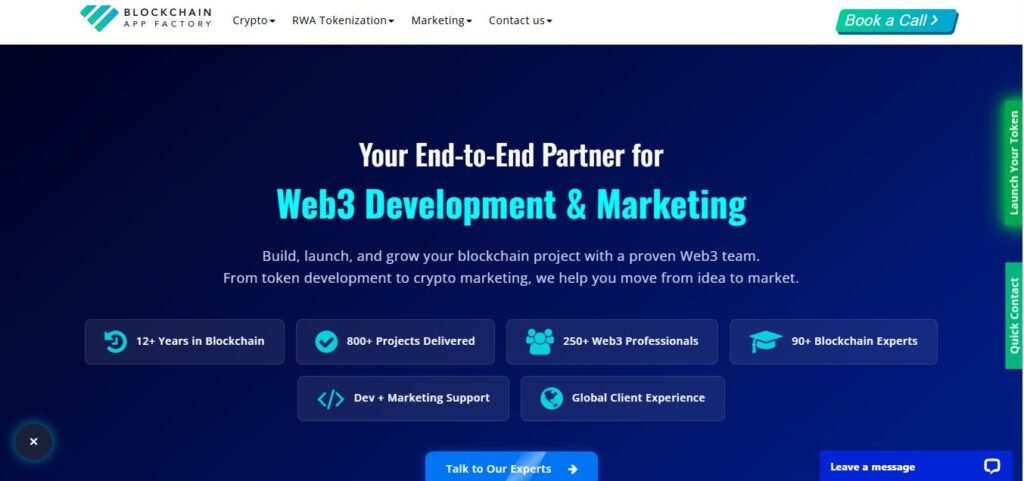
Blockchain App Factory is one of the most experienced blockchain development companies in the USA, with 10 years in the industry, 150+ blockchain developers, and a client portfolio that includes McDonald’s, Shell, RadioShack, and Globant. Their platform covers the broadest range of blockchain product types on this list: NFT marketplaces, cryptocurrency exchange applications, DeFi protocols, metaverse environments, decentralized applications, supply chain management systems, and ICO solutions. Their 85% customer retention rate is one of the strongest signals of delivery quality available in this space.
With 30+ countries served, and a team that combines blockchain-native engineers with strong product design capability, Blockchain App Factory is a credible partner for any business building a consumer-facing blockchain product that needs to be both technically sound and genuinely usable. Their crypto exchange development capability in particular is among the most mature on this list; they’ve built white-label exchange infrastructure that handles real trading volume across multiple asset types.
Why Choose Blockchain App Factory
Their decade of experience and 85% client retention rate are the two data points that matter most when evaluating them. Retention at that level in a technology services business doesn’t happen by accident; it reflects consistent delivery, honest scoping, and post-launch support that keeps clients engaged rather than looking for a replacement vendor after the first project.
Our Experience
Blockchain App Factory delivered a white-label crypto exchange that handled 50,000+ daily active users in the first month post-launch. Their trading engine architecture was well-designed for the load, with no performance issues under peak trading conditions, and the order matching system worked correctly under the edge cases we’d defined in the test plan. Post-launch support response time was fast when we flagged a UI issue in the first week.
Pros & Cons
| Pros | Cons |
| 10 years’ experience, 85% client retention rate | Can be slower to onboard complex new clients |
| Clients include McDonald’s, Shell & Globant | Premium pricing for large-scale exchange builds |
| Broadest blockchain product range on this list | |
| Strong crypto exchange & NFT marketplace depth |
6. LeewayHertz
Price per service: $25,000 – $300,000+
Money-back guarantee: Yes
Delivery time: 12–26 weeks
Overview
LeewayHertz is a San Francisco-based technology firm that brings a rare combination of AI and blockchain expertise to development projects that sit at the intersection of both. Their blockchain development services cover smart contract development and auditing, DeFi protocol engineering, NFT platform development, enterprise blockchain consulting, and the increasingly important category of AI-powered blockchain solutions where machine learning capabilities are layered onto on-chain systems to enable dynamic smart contracts, intelligent tokenomics, and automated compliance monitoring.
Their team works across Ethereum, Hyperledger, Solana, and several emerging blockchain ecosystems, with a delivery model built around outcome validation before engineering begins. They’ve shipped blockchain solutions for clients in healthcare, finance, retail, and logistics sectors where the combination of immutable record-keeping and automated smart contract execution has direct operational value. Their technical documentation is among the most thorough in the industry, which matters when you need to hand a live blockchain system to an internal team for ongoing management.
Why Choose LeewayHertz
LeewayHertz is the strongest choice when your blockchain project has an AI component intelligent automation, predictive tokenomics, machine learning-driven compliance monitoring, or dynamic smart contract behavior based on real-world data inputs. Very few development firms have genuine depth in both disciplines, and the combination is becoming increasingly relevant as blockchain applications become more sophisticated.
Our Experience
LeewayHertz’s AI-blockchain integration work genuinely impressed the dynamic smart contract system they built adjusted settlement parameters based on real-time oracle data in ways that would have required manual intervention with a traditional fixed-logic approach. The engineering documentation they delivered was detailed enough for our internal team to extend the system six months after launch without external support.
Pros & Cons
| Pros | Cons |
| Unique AI + blockchain combined expertise | Premium pricing for complex integrations |
| Strong smart contract audit methodology | Best for projects needing both AI and blockchain |
| Works across Ethereum, Hyperledger & Solana | |
| Thorough technical documentation |
7. Accenture
Price per service: $100,000 – $5,000,000+
Money-back guarantee: Varies by engagement
Delivery time: 20–52 weeks
Overview
Accenture is one of the world’s largest technology consulting firms and has been one of the most active participants in enterprise blockchain development globally. Their blockchain practice has worked on central bank digital currency pilots, multi-party supply chain networks, decentralized finance infrastructure for financial institutions, and government identity systems projects at a scale and regulatory complexity that only a handful of firms in the world are equipped to handle. Their large global ecosystem and deep regulatory expertise allow enterprises to deploy blockchain solutions across jurisdictions and compliance environments that would overwhelm smaller development partners.
Accenture’s blockchain work operates at the intersection of technical engineering and enterprise transformation; they don’t just build the blockchain system; they manage the organizational change required to integrate it into existing operations, regulatory frameworks, and partner networks. For financial institutions, government agencies, and large enterprises where blockchain deployment involves multiple stakeholders, complex governance requirements, and multi-year implementation timelines, Accenture has the depth and scale to manage the full scope.
Why Choose Accenture
Accenture is the right choice when your blockchain initiative has enterprise-wide scope, regulatory complexity, or requires coordination across multiple organizations or jurisdictions. Their CBDC and supply chain network experience in particular is unmatched. If your project involves government relationships, central bank coordination, or cross-border trade finance, they have the institutional relationships and regulatory knowledge to navigate those environments.
Our Experience
The Accenture blockchain engagement covered a multi-party supply chain network across four organizations and two regulatory jurisdictions. The governance framework they designed kept all parties aligned throughout a 14-month implementation. The technical delivery was methodical and well-documented, and the network has handled live transaction volume without incident since launch.
Pros & Cons
| Pros | Cons |
| CBDC & government blockchain experience unmatched | Pricing out of reach for most businesses |
| Manages multi-stakeholder, multi-jurisdiction projects | Very long implementation timelines |
| Global regulatory and compliance expertise | Not suited for startups or mid-market companies |
| Enterprise transformation capability alongside engineering |
8. Appinventiv
Price per service: $25,000 – $300,000+
Money-back guarantee: Yes
Delivery time: 14–28 weeks
Overview
Appinventiv is one of the most recognized technology development firms in the USA, and their blockchain practice builds on the same engineering depth that has made them a trusted partner for enterprise web and mobile development. Their blockchain services cover smart contract development, DeFi platform engineering, NFT marketplace development, enterprise blockchain integration, and tokenization, with a particular strength in connecting blockchain functionality to larger enterprise product ecosystems rather than building standalone blockchain applications that exist separately from the rest of a company’s technology stack.
Their 650+ engineer team gives them the breadth to handle blockchain projects alongside the enterprise system integrations, mobile frontends, and backend infrastructure that a complete blockchain-powered product often requires. For businesses that don’t want to manage separate vendors for blockchain, mobile, and cloud, Appinventiv can handle all three under one engagement model.
Why Choose Appinventiv
Their strength is integration. If your blockchain project needs to connect to an existing CRM, ERP, mobile application, or cloud infrastructure and most enterprise blockchain projects do Appinventiv is one of the few firms that can manage that integration without routing it to a separate partner. That single-vendor approach reduces coordination overhead and keeps accountability clear throughout the project.
Our Experience
Appinventiv integrated a blockchain-based supply chain verification layer into an existing enterprise ERP system without disrupting the operational workflows that the business depended on daily. The blockchain component worked correctly in production from the first week, and the integration with the ERP was clean enough that the internal team could manage it without specialized blockchain knowledge.
Pros & Cons
| Pros | Cons |
| Best-in-class enterprise system integration capability | Premium pricing tier |
| 650+ engineers handle blockchain, mobile & cloud together | Can be slower for pure blockchain-only projects |
| Strong smart contract & DeFi delivery track record | |
| Single-vendor for full enterprise blockchain products |
9. SpaceDev
Price per service: $15,000 – $150,000+
Money-back guarantee: Yes
Delivery time: 10–22 weeks
Overview
SpaceDev is a Miami-based blockchain development company with 7 years of experience, 160+ blockchain projects delivered across five countries, and a 100% positive Clutch review record across 48 verified clients. That last figure is particularly notable; maintaining a perfect client satisfaction record across 48 independent reviews reflects a consistency of delivery that goes beyond a few successful flagship projects. Their specialization covers dApps, NFT platforms, metaverse products, and white-label crypto exchange development on Ethereum, Solana, and Polygon.
Their additional offices in the UK, UAE, and Pakistan give them a global delivery footprint that benefits clients with cross-regional project requirements, including businesses entering the GCC market, where blockchain adoption in real estate, finance, and government services is accelerating. SpaceDev Web3 product capability is well-developed across both consumer and enterprise use cases, and their white-label exchange infrastructure has been deployed in live trading environments handling real user volume.
Why Choose SpaceDev
Their 100% Clutch rating across 48 verified clients is the clearest signal available of how they treat client relationships. In a space where overpromising and underdelivering is common, that track record stands out. For businesses launching Web3 products, particularly NFT platforms and crypto exchanges, where public-facing quality directly affects user trust and adoption, SpaceDev’s consistency is a meaningful competitive advantage.
Our Experience
SpaceDev delivered a white-label NFT marketplace that launched publicly within the agreed timeline. The smart contract security was solid; the platform passed a third-party audit without critical findings, and the user interface was polished enough to drive early adoption without the friction that plagues many first-generation NFT platforms. Post-launch support resolved a minor display issue within 24 hours of it being flagged.
Pros & Cons
| Pros | Cons |
| 100% positive Clutch rating across 48 verified clients | Boutique size limits very large concurrent workstreams |
| 160+ blockchain projects across Web3, NFT & crypto exchanges | Less suited for complex enterprise Hyperledger builds |
| Offices in USA, UK, UAE & Pakistan for cross-regional delivery | |
| Strong white-label exchange & NFT marketplace capability |
10. Vention
Price per service: $20,000 – $200,000+
Money-back guarantee: Yes
Delivery time: 10–22 weeks
Overview
Vention (formerly iTechArt) brings a network of 3,000+ engineers across 30+ countries to blockchain projects that need serious technical depth at scale. Their blockchain practice provides senior smart contract developers, Web3 engineers, and blockchain architects through both team augmentation and full-cycle development models, giving clients the flexibility to plug specialized talent into an existing development team or engage Vention for end-to-end project delivery.
Their engineering capability spans Ethereum, Solana, and multi-chain environments, with particular depth in smart contract development, Web3 backend infrastructure, and DeFi protocol engineering. For blockchain projects where the technical requirements are well-defined but internal engineering capacity is the constraint, either because the company doesn’t have blockchain-specific skills or because the timeline requires more developers than are currently available, Vention’s fast-onboarding talent model provides a reliable solution.
Why Choose Vention
Their onboarding speed is their most practical differentiator. Senior blockchain engineers are among the scarcest technical talent in the market; finding, vetting, and hiring them independently can take six months or longer. Vention can have vetted, senior-level blockchain engineers contributing to your project within days. For companies facing competitive pressure or time-sensitive launch windows, that speed has direct commercial value.
Our Experience
Vention’s Solana engineers joined an existing project team mid-sprint and were contributing meaningfully within the first week. Their smart contract work was clean, well-commented, and followed the security patterns that the internal team had established. A performance optimization they introduced in week three reduced transaction latency by 40% the kind of improvement that comes from genuine Solana-native expertise rather than general blockchain knowledge.
Pros & Cons
| Pros | Cons |
| 3,000+ engineers; fastest access to senior blockchain talent | Requires internal product direction for best results |
| Senior Solana, Ethereum & multi-chain engineers available | Not a full-service creative studio |
| Fast onboarding days, not months | |
| Flexible team augmentation or full-cycle delivery |
Final Thoughts
Blockchain development in 2026 is more technically demanding than it has ever been, and the stakes for getting it wrong have risen in proportion. Smart contract vulnerabilities are exploitable within minutes of deployment. Poor tokenomics design creates systemic weaknesses that show up months after launch. Platform selection mistakes can strand a project on a chain that doesn’t have the throughput, ecosystem, or regulatory acceptance the business actually needs.
The companies on this list represent the clearest options for businesses at different scale and budget levels. Hashtech is a standout for companies targeting both the US and GCC markets, combining genuine technical depth in smart contracts, DeFi, and tokenization with cross-regional delivery experience that most blockchain firms don’t have. For Ethereum-native projects at enterprise scale, ConsenSys and PixelPlex bring a depth of platform knowledge that’s genuinely hard to find elsewhere. For businesses that need blockchain integrated into a larger product ecosystem, Appinventiv’s full-stack capability eliminates the multi-vendor coordination problem. Whatever your starting point, prioritize firms with verifiable production deployments, smart contract audit capability, and honest scoping because in blockchain development, the most expensive mistakes happen before the first line of code is written.
FAQS
What does a blockchain development company do?
A blockchain development company designs, builds, audits, and deploys decentralized applications and infrastructure on distributed ledger networks. Core services typically include smart contract development and security auditing, decentralized application (dApp) engineering, DeFi protocol development, NFT marketplace builds, token creation and tokenization of real-world assets, enterprise blockchain on Hyperledger or Corda, and cryptocurrency exchange development. The best firms handle the full lifecycle from architecture design and platform selection through development, security audit, deployment, and post-launch support.
How much does blockchain development cost in the USA in 2026?
Blockchain development costs in the USA range from $10,000 for basic smart contracts or simple MVPs to over $300,000 for complex enterprise blockchain ecosystems. A mid-tier DeFi protocol or NFT marketplace typically costs between $50,000 and $150,000. Enterprise-grade blockchain networks with regulatory compliance requirements and multi-organization integrations generally start at $150,000 and can exceed $500,000 for large-scale deployments. The biggest cost drivers are smart contract complexity, security audit requirements, platform selection, and the number of integrations with external systems.
How long does blockchain development take?
A simple smart contract can be written and deployed in two to four weeks. An NFT marketplace or basic DeFi protocol typically takes ten to eighteen weeks from scoping to production launch. Enterprise blockchain platforms with complex governance, multi-party integration, and regulatory compliance requirements generally run six to twelve months. The biggest variables are smart contract audit cycles, which add two to six weeks for a thorough security review, and integration complexity with existing enterprise systems.
Which blockchain platform is best for my project: Ethereum, Solana, or Hyperledger?
The right platform depends entirely on your use case. Ethereum is the most widely used for DeFi, NFTs, and public-facing decentralized applications; its ecosystem depth and developer tooling are unmatched, though gas costs and transaction speed can be constraints at scale. Solana offers significantly faster transaction throughput and lower costs, making it a strong choice for high-frequency applications like gaming assets and consumer NFT platforms. Hyperledger Fabric is designed for private, permissioned enterprise blockchain networks where transaction privacy, access control, and integration with existing enterprise systems matter more than public decentralization. A good blockchain development firm will help you make this decision based on your specific requirements, not default to the chain their team knows best.
What is a smart contract audit and do I need one?
A smart contract audit is a systematic security review of on-chain code conducted by blockchain security specialists before deployment. Auditors test for known vulnerability classes: reentrancy attacks, integer overflow, access control weaknesses, oracle manipulation, and flash loan exploits, as well as project-specific logic errors that could allow funds to be drained or contract behavior to be manipulated. Any blockchain project that handles financial value DeFi protocols, tokenized assets, NFT marketplaces with on-chain royalties, or crypto exchange infrastructure requires a professional smart contract audit before launch. Deploying unaudited smart contract code to a live network is one of the most consequential risks in software development.
What are the most common mistakes businesses make when hiring a blockchain development company?
The most expensive mistake is skipping a proper architecture and platform selection phase; jumping straight to development on the wrong chain or with the wrong smart contract structure creates problems that are difficult and costly to fix after deployment. Other common errors include hiring firms that don’t have dedicated smart contract audit capability, accepting project proposals that don’t include a security review phase, and choosing a vendor based on price alone without verifying their production deployment track record. Always ask to see live, working blockchain systems built for past clients, not just case study PDFs or GitHub repositories.
Is blockchain development right for my business?
Blockchain adds genuine value in specific scenarios: when multiple parties who don’t fully trust each other need to share and verify data.
When programmable settlement logic needs to execute automatically without a trusted intermediary. When asset ownership or provenance needs to be publicly verifiable, or when regulatory requirements demand immutable audit trails. It’s not the right solution for every problem; if you don’t have a trust, verification, or programmable settlement challenge.
A well-built traditional database will serve you better at a fraction of the cost. A good blockchain development partner will tell you this honestly during scoping. One that pushes blockchain regardless of your actual requirements is a warning sign worth taking seriously.
